Tell Coca-Cola's New CEO to End Their Plastic Legacy! Sign the petition ➝
21 August, 2026, Kuala Lumpur, Malaysia - Two new studies present a fuller picture of environmental and health conditions around plastic and paper waste recycling facilities in Kuala Langat, Malaysia. One study confirms significant river pollution and microplastic contamination near factory discharge points through direct water quality testing. The other reports elevated rates of self-reported symptoms among nearby residents.
Together, the studies offer some of the first community-level evidence on the potential public health and environmental footprint of Malaysia's plastic and paper waste recycling sector. Malaysia remains one of the world's leading destinations for imported plastic waste.
Key Findings include:
Study 1: This study directly tested river water near the discharge points of plastic and wastepaper recycling factories in the same region, offering evidence for some of the concerns raised by residents in the health survey, particularly related to water quality:
Study 2: A cross-sectional survey of 520 residents living near recycling facilities in Kuala Langat found notable rates of self-reported respiratory, eye and skin symptoms:
Several symptoms were significantly associated with factors such as how long residents had lived in the area, smoking status, and second-hand smoke exposure. Most respondents also raised concerns about fumes, smoke, unpleasant odour and dirty water, which they associated with nearby factories and waste-related activity.
Read together, the two studies offer complementary evidence: a water quality study found measurable, significant degradation in river water near factory discharge points; and residents near recycling facilities widely reported health concerns since the factories were established. The authors caution that two studies should be read as complementary lines of evidence and investigation, rather than direct proof of a causal link between specific pollutants and symptoms.
Why is this important?
As Malaysia continues to import large quantities of plastic waste each year and recycling is concentrated in industrial areas, the researchers argue that community-level health evidence is essential for environmental health surveillance and risk management — particularly in developing-country settings where such research remains scarce.
"Our research in Kuala Langat proves a vital truth: if recycling pollutes our water with microplastics and causes respiratory illness next door, it isn't a solution—it's just outsourced pollution," said Dr Sharifah Norkhadijah Syed Ismail, University Putri Malaysia (UPM).
"Recycling shouldn't cost a community its health. When imported waste turns local rivers into microplastic hotspots, it’s clear: we need cleaner processing, not just green labels," said Dr Nurulain Mustafa Udin, University Technology Mara (UiTM).
"Imported waste doesn't just disappear when it gets recycled—it settles in our rivers and spills into the air our communities breathe. True sustainability means protecting local water and health, not just moving garbage across borders," said Dr Aida Sora Shamsuddin, University Kebangsaan Malaysia (UKM).
The study highlights an urgent need for continuous environmental health surveillance, improved community engagement, and further research that integrates health assessments with air and water quality monitoring near such facilities.
About the Studies
Study 1: Investigating the pollution footprint of imported paper and plastic waste processing plants in Malaysia on water quality and microplastics [Journal of Material Cycles and Waste Management (2026)]: https://doi.org/10.1007/s10163-026-02608-1
Study 2: Perceived health impacts among residents living near plastic and paper waste recycling facilities in Kuala Langat, Malaysia [Environmental Monitoring and Assessment (2026)]: https://doi.org/10.1007/s10661-026-15741-z
For media enquiries or interviews with the study authors, please reach out to: Devayani Khare, Asia-Pacific Regional Communications Officer, Break Free From Plastic: devayani@breakfreefromplastic.org
About the Environmental & Occupational Health Society (EOHS) – a group of energetic and diverse practitioners and researchers brought together by a common interest in promoting distinction in prevention, research, and professional services across the environmental and occupational health field. https://eohsmy.wixsite.com/eohsmy
About Break Free From Plastic – #BreakFreeFromPlastic is a global movement envisioning a future free from plastic pollution. Since its launch in 2016, more than 3,500 organizations representing millions of individual supporters around the world, have joined the movement to demand massive reductions in single-use plastics and push for lasting solutions to the plastic pollution crisis. BFFP member organizations and individuals share the values of environmental protection and social justice, and work together through a holistic approach to bring about systemic change. This means tackling plastic pollution across the whole plastics value chain—from extraction to disposal—focusing on prevention rather than cure and providing effective solutions. www.breakfreefromplastic.org
Kuala Lumpur, Malaysia | 5 July 2025
We therefore declare the following shared commitments and recommendations:
8. Reaffirm plastic pollution as a human rights It endangers the rights to health, clean water, food, work, and a safe environment. ASEAN must treat plastic governance as a human rights imperative—not merely an environmental or waste management concern.
9. Call on ASEAN [Foreign Ministers] and its Member States to:
10. Call on the ASEAN Intergovernmental Commission on Human Rights (AICHR) to:
11. Urge ASEAN Member States to lead the Global Plastics Treaty negotiations by:
12. Commit to strengthening collaboration between civil society and parliamentarians to:
We do hereby declare our shared commitment to take the following actions to ensure ASEAN plastic governance as a human rights imperative:
13. For Parliamentarians:
14. For Civil Society:
15. Specifically, we call on the ASEAN Senior Officials on the Environment (ASOEN), at their 36th Meeting in Langkawi, Malaysia (28 July–1 August 2025), to: [related to opening session]
This joint statement represents a call for shared responsibility, regional solidarity, and transformative action—to reclaim our ecosystems, protect our people, and uphold the environmental and human rights of present and future generations.
For any additional questions or clarifications, please reach out to: devayani@breakfreefromplastic.org.
Organized by:
London, UK [September 16, 2025] - Today, Break Free From Plastic released a new report ‘Supermarket Audits: Stores' Untapped Potential in Fighting Plastic Pollution’, the first-ever global snapshot of the retail sector’s business practices in stores, focusing on their pivotal role in the global plastic pollution crisis.
From August 28 to November 15, 2024, 496 individual audits of 247 retailers in 27 countries were conducted by volunteers from BFFP member organisations, as part of the supermarket audits. Through this global citizen science initiative, BFFP found that stores are doing the bare minimum to reduce their single use plastic footprint, except where strong legislation compels them to.
These citizen science supermarket audits are inspired by BFFP’s successful Brand Audit project, which identified the world's top corporate plastic polluters over the past six years.
Here are the key findings from the report:
Supermarkets are key midstream players in the plastic lifecycle – they lie at a critical junction between producers and consumers, and have significant influence on product producers and consumer behaviour. Yet the role of the supermarket sector in plastic pollution, and its potential for positive change, has been largely overlooked.
BFFP found that a majority of supermarkets successfully prevent one type of plastic pollution by not providing free single-use carrier bags at checkout. Yet, plastic-conscious practices such as bulk dry goods sections, deposit return systems for beverage bottles, deli and butcher counters that allow customers to bring their own containers, and alternatives to plastic produce bags are rarely found in stores around the world.
The report calls on supermarkets to leverage their unique market position to implement comprehensive plastic reduction strategies – these can influence how and what consumers buy, and can reduce plastic waste generation and plastic pollution globally. Supermarkets can also drive supplier innovation and plastic reduction through ambitious targets and procurement policies, while supporting reusable packaging infrastructure, such as existing bottle deposit schemes. Supermarkets should not wait for legislation to act. In the face of the global plastic crisis, which is harming human health, the climate, and the environment, the entire sector needs to urgently address its plastic use.
As negotiations on a global plastic treaty are ongoing, this report offers critical insights into how supermarkets can do so much more in averting the plastic crisis. The study hopes to expand annually and build a comprehensive dataset with more countries and retailers to showcase the best practices and pressure supermarkets to play a proactive role in mitigating the plastic pollution crisis.
QUOTES FROM BFFP MEMBERS
Maria José García Bellalta, founder, Fundación El Árbol, Chile
In recent years, Chile has adopted significant policies, including the Plastic Bag Ban Law (2018) and the Law on Single-Use Plastics and Plastic Bottles (2021), to address plastic pollution. Yet 20 recent audits of supermarkets and convenience stores across two regions reveal that compliance is inconsistent. Large supermarkets have stopped distributing single-use plastic bags, yet many continue to sell so-called “reusable” plastic bags, which ultimately end up as waste once damaged. Smaller convenience stores still freely provide plastic bags to customers, with little to no oversight or enforcement. With Chile’s weak legislation and enforcement mechanisms, stronger and more inclusive measures are needed to address plastic pollution across establishments, accompanied by citizen and retailer education. Most importantly, effective oversight and meaningful sanctions are essential to ensure compliance and to foster real change.
Maite Cortés, Executive Director of the Jalisco Environmental Collective, Mexico.
It is very important that in supermarkets, but also in any other point of sale, consumers have access to products that come in truly circular packaging. This requires redesigning product packaging and making it returnable. As consumers, we want products that are not designed to be disposable because they cause plastic particles to migrate into food.
Daru Setyorini, Executive Director, ECOTON, Indonesia
Plastic overproduction is fueling the triple planetary crisis, and supermarkets have been flooding us with plastic-packed products. Retail chains generate up to five times more packaging waste than traditional shopping — much of it from individually wrapped foods, plastic-bottled drinks, and disposable bags. We saw some supermarkets provide reusable options, but it’s too little and there is a lack of promotion by supermarkets. We want more! We need supermarkets to lead in replacing single-use plastics with locally sourced, plant-based materials and reusable containers. Make sustainable choices accessible, visible, and affordable. We demand eco-friendly packaging in every aisle, so that every purchase moves us closer to a healthier, zero-waste future.
Edith Monteiro, Adansonia.Green, Senegal
Every aisle in the supermarket can be part of the problem or part of the solution. Choosing less plastic means choosing a healthier future.
Emma Priestland, Corporate Campaigns Coordinator, Break Free From Plastic
This first ever snapshot of global supermarket business practices clearly shows that the sector has a long way to go in preventing plastic pollution. Supermarkets around the world are heavily reliant on single-use plastics, and this overconsumption is a key reason we are in a pollution crisis today. By implementing some simple and proven measures, stores can massively reduce their plastic footprint, and help their customers avoid unnecessary plastic - good for their health and the environment!
Note to the editors:
Access the Supermarket Report & Results.
Here’s a photo bank with image credits and suggested captions to feature in your articles.
Press Contacts:
Emma Priestland, Corporate Campaigner, Break Free from Plastic: emma@breakfreefromplastic.org
About Break Free From Plastic – #BreakFreeFromPlastic is a global movement envisioning a future free from plastic pollution. Since its launch in 2016, more than 3,500 organizations representing millions of individual supporters around the world, have joined the movement to demand massive reductions in single-use plastics and push for lasting solutions to the plastic pollution crisis. BFFP member organizations and individuals share the values of environmental protection and social justice, and work together through a holistic approach to bring about systemic change. This means tackling plastic pollution across the whole plastics value chain—from extraction to disposal—focusing on prevention rather than cure and providing effective solutions. www.breakfreefromplastic.org
August 4th, 2025 Geneva, Switzerland – A day before the final round of negotiations for a Global Plastics Treaty starts, hundreds of citizens and civil society organisations from across the world gathered at Place des Nations in Geneva to demand an ambitious and legally binding treaty that puts people and the planet before polluters.
The demonstration, organised by Greenpeace Switzerland and the Break Free from Plastic movement, the Gallifrey Foundation and a growing coalition of environmental and social justice groups, kicked off the last phase of the UN negotiations taking place from 5 to 14 August at the Palais des Nations. Protesters wore yellow, red and orange to symbolise the urgency of the crisis and the danger posed by the unchecked production of plastic, which is overwhelmingly derived from fossil fuels.
“As host country of the negotiations on plastic pollution, we count on Switzerland to stay firm on the ambition of the future Global Treaty. With plastic production set to triple by 2050, the treaty would be bound to fail without a global target to reduce plastic production. We need to end the age of plastic to protect our health, our communities and our planet” said Joëlle Hérin, expert in consumption and circular economy at Greenpeace Switzerland.
With negotiations about to begin, civil society is calling out the role of the fossil fuel industry in undermining progress, and urging delegates to focus on upstream measures that tackle plastic production at its source.
“At the previous round of negotiations, we counted 221 lobbyists from the fossil fuel and petrochemical industries. If they had formed a single delegation, it would have been the largest at the talks, far outnumbering that of the European Union and its Member States combined (191). This overwhelming presence shows just how threatened these industries are by a strong Plastics Treaty. With Geneva being a major hub for crude oil and petrochemical trade, their numbers could be even higher this time.
Civil society has had enough of their manipulation and delay tactics. The world can now see clearly: plastics and the climate change crisis are fuelled by the fossil fuel industry. A handful of companies are impacting billions of lives. We need a robust and legally binding Treaty. Now. We are all watching”, said Laurianne Trimoulla, Communications and Project Manager of the Gallifrey Foundation.
The mobilisation marks a powerful show of unity from citizens and NGOs determined to protect human health, human rights, and ecosystems from the escalating plastic pollution crisis.
"A strong global plastics treaty isn't just about reducing pollution — it’s our opportunity to end the injustice of waste trade, ensuring that no community becomes a dumping ground for another’s excess. A meaningful treaty must close loopholes that disguise waste trade as recycling. Switzerland's plastic waste exports to Malaysia have increased significantly, 271%, from 69,820 kg in 2022 to 258,897 kg in 2024. By curbing waste trade, the plastics treaty can shift nations such as Switzerland from exporting pollution to investing in upstream solutions and taking responsibility for their own waste” said Mageswari Sangaralingam, from Sahabat Alam Malaysia.
###
Notes to the editor
About Greenpeace – Greenpeace exists because this fragile earth deserves a voice. Founded in 1971 by a group of concerned citizens who sought to halt nuclear weapons testing by the United States military off the coast of Alaska, Greenpeace now operates in 55 countries and territories across the globe. Our mission is to protect biodiversity in all its forms and to address the climate crisis with the urgency it demands. We are guided by our core values of non-violence, personal accountability, independence, and a commitment to highlighting not only environmental problems but also creating practical and hopeful solutions.
About the Gallifrey Foundation — The Gallifrey Foundation is an ocean protection organisation founded in Geneva. Topics covered include, but are not limited to: plastic and related chemical pollution, shark protection, deep seabed mining, ecocide, overfishing, ocean rights, whaling. Plastic Free Campus is a free programme run by the Foundation to help schools “de-plastify” their campuses.
About BFFP — #BreakFreeFromPlastic is a global movement envisioning a future free from plastic pollution. Since its launch in 2016, more than 2,700 organizations and 11,000 individual supporters from across the world have joined the movement to demand massive reductions in single-use plastics and push for lasting solutions to the plastic pollution crisis. BFFP member organizations and individuals share the values of environmental protection and social justice and work together through a holistic approach to bring about systemic change. This means tackling plastic pollution across the whole plastics value chain – from extraction to disposal – focusing on prevention rather than cure and providing effective solutions. www.breakfreefromplastic.org.
Global Press Contacts:
Regional Press Contact:
Saabira Chaudhuri recently released her book, 'Consumed: How Big Brands Got Us Hooked on Plastic’. For a decade, Saabira has written about the consumer goods industry for The Wall Street Journal from London. She has reported on large, publicly traded companies as well as broader industry trends in the U.S., Europe and elsewhere, with a particular interest in how our consumption of everyday products is increasingly affecting our environment and our health. To understand the inspiration for her book, we reached out to Saabira with some burning questions, and here are her answers:
Q. In Consumed - How Big Brands Got Us Hooked on Plastic, you retrace the story of sachets in India. Can you tell us how, where and by whom were sachets created?
In Consumed, I write about a Cuddalore, Tamil Nadu-based schoolteacher named Chinni Krishnan who, in the late 1960s, started a business repackaging powdered pharmaceutical products into small portions. These were aimed at poorer people who couldn’t afford larger packs. At the time in India, a handful of dry products like tea and gutkha were sold in small sachets, but Chinni Krishnan wanted to go further. He began looking for ways to package liquids in sachets, eventually creating a pouch made from polyvinyl chloride. He used the pouch to sell a new shampoo brand he called Velvette. After he died, his son, CK Ranganathan, launched another shampoo brand called Chik, also in sachets. He employed a particularly creative marketing model, going from village to village in South India to conduct hair-washing demonstrations. Packaged in sachets, Chik shampoo was affordable to millions of Indians who had otherwise used reetha (soap berries) and amla (gooseberries) or just bar soap. Sales began to tick up.
It wasn’t long before Hindustan Lever – Unilever’s India subsidiary – took notice. Starting in 1987, Hindustan Lever began putting its Sunsilk and Clinic shampoo in sachets. It coupled this with mass-market advertising, explaining how sachets should be used and how using commercial shampoo could lead to straight, shiny hair. A few years later, when Procter & Gamble entered India’s shampoo market, the Cincinnati-based consumer goods giant launched Pantene in bottles but also in sachets, which by then accounted for the vast majority of shampoo sales in India. The multinationals didn’t limit their ambitions to the south. They took sachets across the country, including to some of its most remote areas, places that didn’t have organized waste collection, let alone recycling.
Q. What exactly is the issue with sachets? Why has their proliferation created so many problems for both corporations and communities?
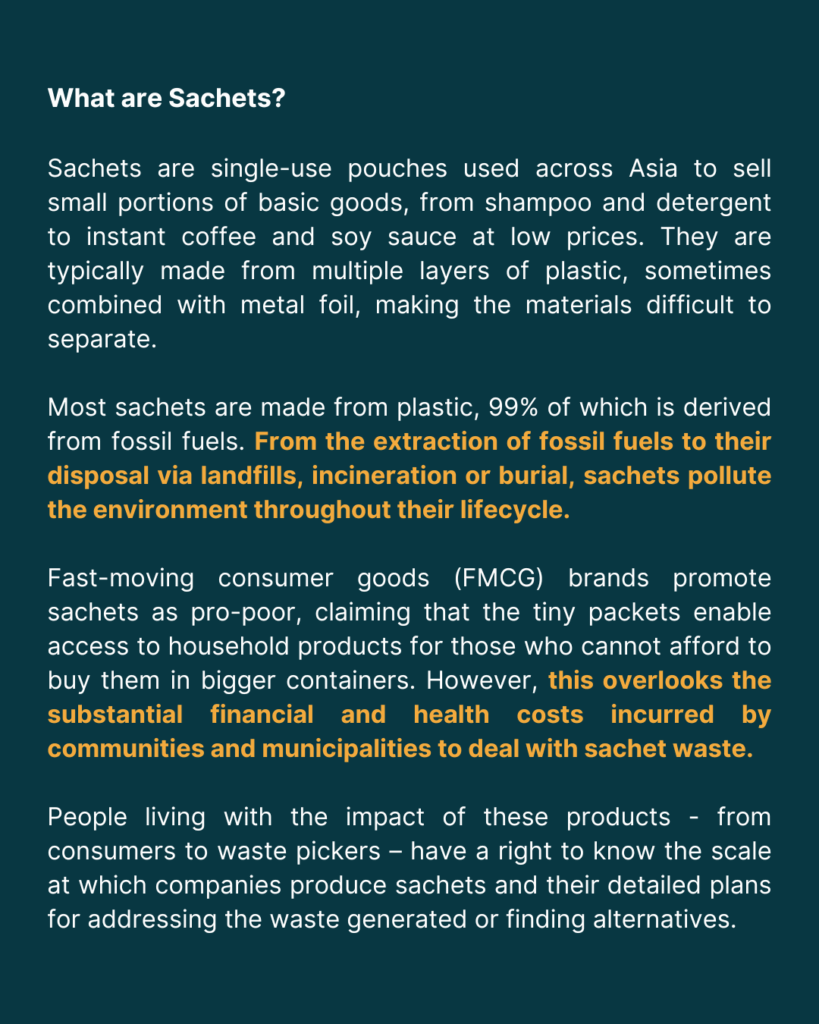
Every sachet discarded today is landfilled, burned, dumped or littered – many near or in water bodies where they fragment into microplastics. The sachets were never designed to be recycled – they’re made of a blend of plastic and aluminium that is expensive to separate. Their size also makes them expensive to collect and sort. A main problem is just how many of them there are - in 2021, in India alone, nearly 41 billion shampoo packages were sold, of which 99% were sachets. Sachets have spiralled well beyond shampoo and are used for everything from hair oil and pickle to laundry detergent and mosquito repellent.
Activists continually pressure Unilever and others to stop selling sachets and the tiny plastic pouches have turned into a reputational bugbear. The companies argue that scrapping sachets would mean poor people couldn’t access their brands. The flip side, of course, is that the environmental harms from dumping and burning used plastic are felt most by poorer people.
Through my reporting for Consumed, I learned that the popularity of sachets came as a surprise even to the companies that created them. Companies like CavinKare, Unilever and P&G saw sachets as a tool to sell to India’s poorest but in fact, sachets have been adopted by a far wider swathe of the population. They’re convenient, portable and allow a wide variety of choices. Strangely, in India, they are often more economical than buying bottles of shampoo or detergent, flying in the face of industry precedent that says bigger is cheaper.
Companies are definitely cognisant of the problems sachets are causing but say they haven’t found an alternative material that can as effectively protect the product within.. While reuse models have been explored, they’ve never scaled because buying sachets is cheap, convenient and people have access to a wide variety of brands.
Q. Can you elaborate on some of the tactics used by big brands in the Global North and the Global South to get us hooked to plastic?
A big message globally over the past eighty years has been that plastics are synonymous with hygiene. Starting in the 1930s, companies like DuPont began pushing the idea that wrapping food in plastic kept germs away and that unwrapped food was not just dirty but irresponsible - a hazard to a family’s health.
Another big hook is convenience, a value that really took root in the 1950s. The industry developed disposable everything over this decade and the message to overworked American housewives who were increasingly entering the workforce was that plastics could free them from drudgery.
Of course, while plastics can help protect food and make life more convenient, they’ve also helped companies slash costs, lengthen supply chains and spur consumption – all of which have combined to bring about a massive overuse of single-use plastic.
A tactic companies have employed to keep people hooked on plastic – and disposability – is warning of huge price rises should lawmakers move to change anything about the way business is currently done, where the cost of dealing with waste is outsourced onto taxpayers and the end-of-life costs of plastic are in no way reflected in the price consumers pay.
Companies have also regularly funded studies called “life cycle analyses” espousing their position (which is usually that plastics are environmentally the best material for any particular use case), often without disclosing that they’re the ones behind the studies. Life cycle analyses are very complex, relying on a whole range of assumptions and the results can vary hugely depending on who is conducting the studies and what assumptions are made.
Q. If there’s one idea or key takeaway from the book on the issue of plastic pollution, what would it be?
If I had to pick just one, it’s that none of the many high-profile promises companies have noisily made over the past four decades to slash plastic use and waste have worked. Far from tackling the problem, companies are using more plastic than ever and are falling even further behind.
I have an analogy in my book where I compare the big consumer goods companies to drug addicts – they’re aware they have a problem, many of them genuinely see the need to cut back on single-use plastic, but they’re so deeply dependent on disposability as a business model that they’re unable to make changes. And so they employ the same tactics year after year, make the same overblown promises, fund the same sorts of studies justifying their existing business models, and roll out the same “pilots” and “trials” that never scale.
I see regulation as akin to rehab - we as consumers need to push our elected representatives to rewrite the rules by which companies are allowed to do business. We also need to push companies themselves to stop lobbying against proposed regulations that would cut waste and emissions. We should not just vote with our wallets but also call out companies that greenwash or act irresponsibly, telling them of our displeasure and how we’ll be shopping elsewhere from hereon.
Remaining silent and leaving it up to companies to voluntarily make the necessary changes will never lead to the big shifts we need to truly slow the production of plastic, reduce our dependence on disposable products and packaging and cut waste. The various stories in Consumed – which span several decades and show the same patterns across all of these – underscore this.
Q. In your final chapters, you speak of where we are today, and where we go from here. Do you feel the Global Plastics Treaty offers some hope, or a framework for other policies on curbing the issue of plastic pollution?
Having a global treaty in place could be useful, given nothing but regulation will push companies to change how they do business. How useful it is depends on what can be agreed on, how strictly it’s implemented and who signs.
When it comes to policy measures, the lowest-hanging fruit involves pushing companies to think about whether they need to use disposable packaging at all and, if they do, how to design it so that it’s easy to recycle or reuse, is free of harmful chemicals and doesn’t shed microplastics. Extended producer responsibility, a policy that transfers the cost of dealing with the waste generated by products from taxpayers to the companies that make the products, is a first step towards funding waste collection infrastructure. A more sophisticated version of EPR involves “eco-modulated” fees, which are levied based on how environmentally harmful a product or packaging is. This should ultimately push companies to make better design choices.
Reuse and waste reduction targets could spur the development of standardized packaging for reuse and refill – along with collection and washing facilities to service these. Overall, laws that narrow the types of plastics (and chemicals) allowed on the market, and the uses these are allowed for, could help us begin to get a handle on waste but also improve human health, which is increasingly a concern because of the thousands of chemicals that are used in plastics. It’s important to say that simply switching to another disposable material, like paper, comes with its own environmental consequences, and generally, this isn’t a path I advocate for. To truly break free from the cycle of make-consume-throw we need to think about shifting overall behaviour and the economics underpinning how we consume.
Ultimately, while a global treaty could play an important role in mandating these kinds of laws across countries, real progress will also depend on public engagement. Individuals need to become more informed and actively involved—holding companies accountable for their role in driving plastic dependency, and reflecting critically on our own habits as consumers within an economy built on endless consumption. Systemic change won’t happen without pressure from the ground up, alongside top-down regulation.
(Photo Essay) The Story of Sachets
(Report) Branded: The Sachet Scourge in Asia
(Report) Sachet Economy: Big Problems in Small Packets
(Report) Missing the Mark: Unveiling Corporate False Solutions to the Plastic Pollution Crisis
On July 23, 2025, the #BreakFreeFromPlastic movement hosted a comprehensive media briefing to provide journalists with essential context ahead of the INC 5.2 negotiations for the Global Plastic Treaty.
The online briefing featured regional policy experts who discussed country positions and negotiation dynamics of the Asia Pacific region, to help media personnel prepare for INC 5.2 coverage, and better understand how countries frame their priorities around economic development, environmental protection, and regional and international cooperation.
Asia Pacific countries sit at the epicentre of both plastic production and pollution impacts; the region's diverse economies and environmental challenges make it a key battleground in the global treaty negotiations. The negotiation outcomes will determine global standards for plastic production, waste management, and industry accountability.
The briefing also identified key challenges, including procedural issues affecting civil society access, potential delaying tactics, watered-down commitments favouring waste management over production caps, and industry influence promoting circular economy narratives over substantive pollution reduction. For a more nuanced coverage of the treaty, the policy experts and researchers on the panel urged journalists to consider a human rights-centric, fossil-fuel-free development model for the Asia Pacific.
KEY TAKEAWAYS
UN member-states are set to reconvene in Geneva, Switzerland on August 5-14, 2025 for the resumed fifth session of the Intergovernmental Negotiating Committee (INC 5.2) for an international legally binding agreement to end plastic pollution.
KEY QUOTES
Semee Rhee, Global Policy Advisor, Break Free From Plastic
“It's not about whether or not we will have a treaty. It's about how many countries will be courageous enough to say that we can no longer continue producing the amount of plastics we currently produce for the sake of the environment and human well-being.”
Siddharth Ghanshyam Singh, Centre for Science & Environment (CSE)
“The moment to push for ambition is now. Opportunities like this don’t come often, and countries must remember who they are negotiating for; their people and our shared planet. We cannot allow a few vocal opponents to derail and delay progress. It’s time to stand firm and take a decisive step toward ending plastic pollution.”
Pinky Chandran, Asia Pacific Coordinator, Break Free From Plastic
“The plastic problem often resembles a kaleidoscope, with no single perspective illuminating the complete picture; in fact, each turn reveals a new representation. We must view the plastic problem as a tapestry, where every element is interconnected, interlinked, and interdependent. A fragmented, piecemeal approach simply won't suffice. And so there must be global binding measures to reduce plastic production, in order to tackle the plastic pollution problem, through a just transition lens”.
Siddika Sultana, Executive Director, Environment and Social Development Organization (ESDO)
"South Asia is both a significant hotspot for plastic pollution and a center of innovation. To address this issue effectively, the region must shift from isolated national initiatives to coordinated regional action. A united approach—supported by enforcement, investment, and inclusivity—can establish South Asia as a leader in developing an effective global treaty on plastic waste."
Punyathorn Jeungsmarn, Plastics Campaign Researcher, Environmental Justice Foundation
“As a region, Southeast Asia is particularly affected by plastic pollution, and is increasingly becoming the dumping ground for plastic waste, misguided false solutions such as waste-to-energy technologies, and petrochemical expansion. It is therefore crucial for our representatives to stand up and put people and the planet over plastics and the petrochemical industry. Throughout the past rounds of negotiations, we have seen courageous stances from Southeast Asian countries. We hope to see those again in Geneva.”
Additional Resources:
Note: High-resolution images of spokespeople and additional background materials are available upon request. Interview opportunities with regional experts can be arranged following the briefing.
Press Contacts:
About Break Free From Plastic – #BreakFreeFromPlastic is a global movement envisioning a future free from plastic pollution. Since its launch in 2016, more than 3,500 organizations representing millions of individual supporters around the world, have joined the movement to demand massive reductions in single-use plastics and push for lasting solutions to the plastic pollution crisis. BFFP member organizations and individuals share the values of environmental protection and social justice, and work together through a holistic approach to bring about systemic change. This means tackling plastic pollution across the whole plastics value chain—from extraction to disposal—focusing on prevention rather than cure and providing effective solutions. www.breakfreefromplastic.org
08 July 2025, Kuala Lumpur—Parliamentarians and civil society representatives from Malaysia, Indonesia, Thailand, the Philippines and Vietnam gathered in a civil society-led workshop to address the growing crisis of transboundary plastic pollution and its devastating impact on human rights across Southeast Asia. The gathering served as a platform to exchange knowledge, explore regional and national laws on plastic waste trafficking and discuss rights-based solutions within the context of the Global Plastic Treaty negotiations with the aim of fostering coordinated ASEAN action on this urgent environmental and socio-economic issue.
Edmund Bon Tai Soon, Chair and Representative of Malaysia, ASEAN Intergovernmental Commission on Human Rights (AICHR)
Southeast Asia is the region most impacted by the pressing issue of plastic pollution, production and consumption; it is not just an environmental issue but a human rights issue. Plastic pollution affects food security, right to health, right to life. It disproportionately affects women, children and communities in environmentally fragile areas. This workshop is important in placing human rights at the centre of the plastic pollution crisis - parliamentarians, whether in government or in opposition, and with your access to the media, are important and influential.
Key Outcomes:
1. Civil society organizations (CSOs) proposed a human-rights centric joint statement to the parliamentarians, lawmakers and house representatives present;
2. Participants were able to discuss, deliberate and decide on key issues, wording and framing of the joint statement to better represent our unified voices, and have agreed to use it as a lobbying tool at the national, ASEAN and international levels; and,
3. There were suggestions on how the joint statement could be used for future lobbying, by both parliamentarians, customs officials and CSOs, and the upcoming meetings at which our demands can be articulated.
Key Quotes from Parliamentarians & the Joint Statement:
YB Datuk Willie Anak Mongin, MP of Puncak Borneo, Malaysia
This workshop has reaffirmed my commitment to advocate for a rights-based approach to environmental protection. One key takeaway is the urgent need for regional cooperation in ASEAN to strengthen plastic governance, support waste reduction at the source, and ensure that environmental policies are grounded in human rights principles. We must move beyond seeing plastic pollution as merely a waste management problem. It is a human rights issue that demands integrated solutions involving public participation, corporate accountability, and legal reforms.
Renee Co, Kabataan Partylist Representative, the Philippines
Plastic pollution is a human rights issue – and ASEAN countries are victims of multiple facets. From being treated as a “waste bin" by developed / polluter countries as they illegally transport and import trash (which sometimes include toxic or hazardous wastes) to being the target of aggressive imperialist consumerism culture, Southeast Asian countries, its citizens, and its youth bear the brunt of this struggle.
Rina Sa’adah, National Awakening Party (PKB), Indonesia
In this workshop, the parliamentarians present agreed on a very comprehensive joint statement to solve plastic pollution that will be forwarded to higher forums, both at the ASEAN regional level, and the global level. The important message conveyed through this workshop is, "The import of plastic waste from developed countries is not just a matter of recycling or circular economy, but more fundamentally it is an interference with the sovereignty of ASEAN countries. Therefore, ASEAN countries need to increase collaboration in preparing strategies to stop the import of plastic waste in the ASEAN region.
Norasate Prachyakorn, Senator, Senate of Thailand
Before I came to this meeting, I was fighting against plastic waste companies and government agencies in Thailand over corruption. What I’ve learned is the importance of cooperation. As countries, we face similar problems when it comes to law enforcement. What we all know is that we can’t do this alone — we have to work together, as a coalition, as friends, and as a region. Over the course of this one-and-a-half-day workshop, I’ve developed a strong feeling that we can do it. We can fight this together.
Access the joint statement here.
The joint statement, with due inputs from parliamentarians, customs officials and civil society organizations present at the workshop, will be used for future advocacy efforts at the local, ASEAN and international levels.
For media inquiries:
Pats Oliva: Media and Communications Manager| ASEAN Parliamentarians for Human
Rights (APHR) | pats@aseanmp.org
Devayani Khare: Regional Communications Manager | Break Free From Plastic - Asia
Pacific (BFFP-AP) | devayani@breakfreefromplastic.org
ORGANIZING PARTNERS
Break Free from Plastic (BFFP) & ASEAN Parliamentarians for Human Rights (APHR)
With support from BFFP members from the Asia Pacific region:
Basel Action Network (BAN), Center to Combat Corruption and Cronyism (C4 Center), Sahabat Alam Malaysia (SAM), Consumers’ Association of Penang (CAP), Pacific Environment and Resources Center Vietnam (PE-VN), Environmental Justice Foundation (EJF), Ecological Observation and Wetland Conservations (ECOTON), BAN Toxics, and EcoWaste Coalition.
BUSAN, Republic of Korea, November 29, 2024 — A broad coalition of observer organizations held a press conference outside of the fifth Intergovernmental Negotiating Committee (INC-5) to advance a plastics treaty. The organizations demanded that negotiators come together to show courage and not compromise in the final days of the negotiations.
The organizations delivered the following statement:
There are only 36 hours left of scheduled negotiations to secure a global treaty that can end plastic pollution. But right now, we see the usual low-ambition countries derailing the negotiations while the countries who have pledged ambition, such as members of the High Ambition Coalition (HAC) and who sit comfortably in the majority, are sleepwalking into a treaty that will not be worth the paper it will be written on. Negotiators are sticking with business as usual at such a crucial stage, abandoning their commitments, ignoring their principles, neglecting the science and economics in front of them, and failing those most impacted. All in the pursuit of consensus and finalizing any kind of treaty by the end of this week, regardless of how catastrophically futile it will be in addressing the worsening plastic crisis.
Contrary to their excuses, ambitious countries have the power and the pathways to forge a treaty to end the global plastic crisis. What we are severely lacking right now, however, is the determination of our leaders to do what is right and to fight for the treaty they promised the world two years ago.
A weak treaty based on voluntary measures will break under the weight of the plastic crisis and will lock us into an endless cycle of unnecessary harm. The clear demand from impacted communities and the overwhelming majority of citizens, scientists, and businesses for binding global rules across the entire lifecycle is irrefutable. The vast majority of governments know what now needs to be done. They know what measures we need and they know how they can be implemented. Negotiators have several procedural options available, including voting or making a treaty among the willing. In these final throes of negotiations, we need governments to show courage. They must not compromise under pressure exerted by a small group of low-ambition states and hinge the life of our planet on unachievable consensus. We demand a strong treaty that protects our health and the health of future generations.
Notes to the editor:
Photos from the INC-5 Day 5 Press conference are available here. Credit to Greenpeace.
Read about the March to End the Plastic Era: https://bit.ly/INC4march
Translations in French and Spanish will be available here.
Civil society groups from around the world came together in a mass mobilization at the fourth session of the Intergovernmental Negotiating Committee (INC-4) for a Global Plastics Treaty in Ottawa, Canada, as well as in different satellite actions in multiple locations globally, to center the goals and values of communities most impacted by the plastic lifecycle. The march took place on 21 April 2024 (Sunday) at Parliament Hill and the Shaw Center to remind governments who exactly they are negotiating for at the INC.
These are the key demands from the civil society groups for delegates at INC-4:
March 1st, 2024, Nairobi - Today concluded the sixth UN Environment Assembly (UNEA 6), bringing representatives from 193 countries to Nairobi, Kenya, to consider proposals for “Effective, inclusive and sustainable multilateral actions to tackle climate change, biodiversity loss, and pollution.” After a week of discussions, #BreakFreeFromPlastic members on the ground continued calling for governments to push for an ambitious Global Plastics Treaty in preparation for the fourth round of negotiations that will take place in Ottawa, Canada, in late April.
Amid concern over attempts to limit the mandate of the plastics treaty during the week, Hellen Kahaso Dena, Project Lead of the Pan-Africa Plastics Project at Greenpeace Africa, said, "A few countries are attempting to water down the already agreed language on ending plastic pollution by 2040, reducing ambition on all fronts, and denying the link between chemicals and the climate crisis. We strongly urge member states not to undermine the mandate of the Global Plastics Treaty, and show courage and ambition as we continue the negotiations in Ottawa next month." –Read Greenpeace's full statement here.
David Azoulay, Director of the Center for International Environmental Law’s Environmental Health program, responded, “we welcome the renewed commitment to engage constructively in the ongoing negotiation of an international legally binding instrument on plastic pollution. Unsurprisingly, the same Member States who have worked to derail and obstruct the plastics treaty negotiations resort to a backdoor effort to attempt to renegotiate the INC’s mandate. While this declaration has no legal bearing on the mandate for the INC’s work, reaffirming the mandate at UNEA-6 is a valuable political statement in the face of continued bad-faith engagement by the United States and petrostates who are trying every means to limit the ambition of the future treaty. Governments need to respect their previous commitments and listen to the independent scientists and communities around the world who are demanding ambitious action. They must right the ship ahead of INC-4 to ensure the negotiations in Ottawa do not end in failure.” –CIEL's statement is also available here.
Ana Rocha, Director of Global Plastics Program for GAIA, added, "UNEA6 was a clear representation of the world’s political complexity and imbalance. When it comes to the Plastics Crisis, a handful of countries constantly tried to isolate and reduce the significance of resolution 5/14 that originated the Plastic Treaty negotiations. Thankfully, the commitment to urgently eliminate plastic pollution across the full lifecycle of plastics was once again reinforced in the Ministerial Declaration. We leave Nairobi with hope that the upcoming fourth round of negotiations in Canada will move us towards an ambitious Plastics Treaty."
Frankie Orona, Executive Director for Society of Native Nations also commented on the UNEA 6 meeting, "we found during UNEA 6 that many oil states tried to dilute, prolong and stop any progress related to the Global Plastic Treaty INC. We have found once again, an inequitable participation when it comes to including the voices of Indigenous Peoples, Frontline communities and workers, who are disproportionally impacted by the fossil fuel, petrochemical, agriculture and chemical industry. The issues in our impacted communities should not be considered just a human health and environmental issue but more of a human rights issue."
Rahyang Nusantara, Deputy Director of Dietplastik Indonesia, said, UNEA-6 was an opportunity to create a better strategy prior to the next INC-4 towards the Plastics Treaty. During side events and side meetings I was involved in, there was a lot of conversations on plastic pollution and especially around reuse as a solution, however I noticed a lot of different interpretations of the word. Reuse is not recycling and it is not only a packaging but also a system. Success of plastic reduction measures will depend on the scaling up of accessible sustainable alternatives. Reuse systems and refills are often the most sustainable option as compared to single-use substitutions and reuse systems should be material-agnostic. I look forward to more discussions and intersessional work to ensure that Reuse is central to achieving “Resolution 5/14 End plastic pollution: towards an international legally binding instrument”
On a separate note, BFFP member IPEN celebrated UNEA's call for action to end the use of the world’s most toxic pesticides by 2035, which continues to drive the connection across environmental issues and the petrochemical impacts on human health, including pesticides and plastics.
Additional BFFP's statements will be added as they become available.
###
About Break Free From Plastic – #BreakFreeFromPlastic is a global movement envisioning a future free from plastic pollution. Since its launch in 2016, more than 2,000 organizations and 11,000 individual supporters from across the world have joined the movement to demand massive reductions in single-use plastics and push for lasting solutions to the plastic pollution crisis. BFFP member organizations and individuals share the shared values of environmental protection and social justice and work together through a holistic approach to bring about systemic change. This means tackling plastic pollution across the whole plastics value chain—from extraction to disposal—focusing on prevention rather than cure and providing effective solutions.www.breakfreefromplastic.org


