When Typhoon Ondoy hit in September 2009, the river was so densely clogged with trash that people said one could almost walk across it. Soon, waste seeped into homes: cellophane, sachets, snack wrappers, sando bags (plastic bags), styrofoam. In every typhoon, it would take time for residents to return to their normal routines, as both the community and the barangay would spend weeks cleaning the streets.

Residents are walking above debris and waste on Tullahan river.
Like with most other barangays, clean-up drives became Potrero’s first course of action in response to these concerns.
But these solutions, while done in earnest, were temporary and ultimately futile, exhausting both manpower and resources with little long-term impact. Waste always returned, and so did the floods. Potrero needed more than brooms and good intentions to break the cycle.
Cutting Plastic Pollution Off at the Source Through Tingi Tindahan
Residents had long adapted to the recurring floods. Their routines were shaped by the expectation that trash would keep coming and that floods, in turn, would keep rising. Yet beneath that resignation was a quiet desire for change.
The barangay knew they needed to do something bigger. In 2014, with the assistance of Mother Earth Foundation (MEF), a nonprofit organization and member of Break Free From Plastic, they began implementing zero waste programs aligned with Republic Act No. 9003—the country’s landmark law establishing a comprehensive, community-based solid waste management system.
Regine Nayve, who oversees MEF’s community-based solutions for plastic pollution as Program Officer said that Potrero already had the ingredients for transformation: leaders willing to listen, collectors open to training, and residents who knew, deep down, that the old cycle was no longer sustainable.
This made the barangay a suitable venue to host MEF’s Zero Waste Program, an ecological waste management initiative designed to cut down landfill-bound waste in grassroots areas across the Philippines. The partnership lasted for eight months but Potrero work hard to continue the progress.
Many things changed—and improved. But they soon realized that waste management was only one part of the equation and, on its own, was not enough to solve the problem. Plastic waste continued to plague the community.
In response, they launched the Tingi Tindahan. Funded by the local barangay and supported once again by the MEF, the initiative aimed to address the root cause of the issue: single-use plastics. The Tingi Tindahan is a barangay-run refill store modeled after the traditional sari-sari store but without the plastic packaging that had long burdened the barangay.
Potrero’s shift began with building “systems that would enable us to shift to refill and reuse,” Regine said. “[These] would help us reduce [residents’] dependency on plastics."
She added, “We [should] aim for solutions that [serve as] alternatives to continuously using single-use plastics.”
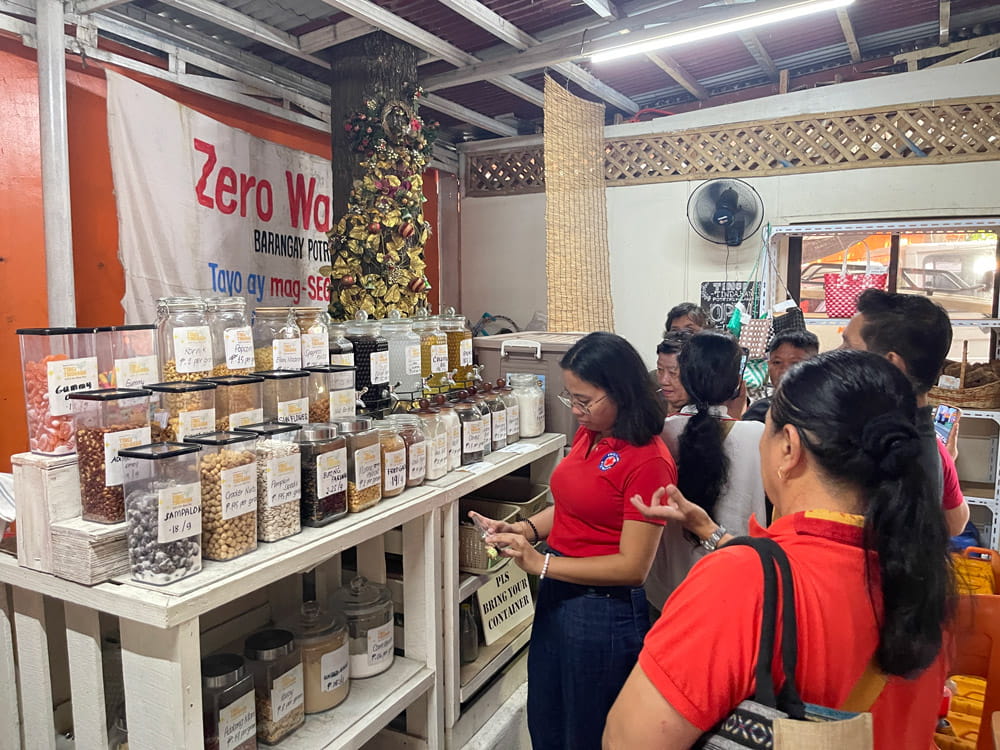
Inside the Tingi Tindahan reuse and refill store
Instead of selling goods in sachets, the project revived the old Filipino practice of refill and reuse.
The system quickly resonated with residents, who appreciated its simplicity. Instead of buying sachets, they simply have to bring any jar or container, have it weighed, refill it, and pay only for the contents. Prices often come out cheaper — for as little as ₱5 (USD 0.08) or ₱10 (USD 0.17) — while generating virtually no new waste.
“Ang goal ng Tingi Tindahan ay para makabawas sa basura ng aming barangay,” explained Khate Nolasco, an incumbent barangay councilor or kagawad. (“The goal of Tingi Tindahan is to lessen the waste produced in our barangay.”)
This embodies the essence of the Zero Waste approach, Regine said: “Ang ibig sabihin talaga ng ‘zero waste’ dito sa atin ay walang aksaya.” (“What ‘zero waste’ truly means for us is that nothing goes to waste.”)
Tingi Tindahan encourages a behavioral shift away from single-use plastics and toward a culture of reuse and refill. Barangay captain Sheryl Nolasco welcomes this return to an older, more sustainable habit. “Gustong-gusto kong bumalik ‘yung ganung tradisyon at matutunan ng mga bata ngayon,” she said. “Ine-encourage natin silang gawin ito, hindi lang para makatulong sa environment, kundi para rin sa kanilang katipiran.” (“I really want that tradition to return, and for today’s children to learn it… We encourage them to practice this not only to help the environment, but also to teach them thriftiness.”)
Tingi Tindahan gave Potrero a way to stop plastic waste before it starts. Now community-run and kept low-cost, the model now stands as a potential blueprint for barangays looking to replicate the same zero-waste initiative.
In fact, Kgwd. Khate believes the approach can scale nationwide: “Napakarami nating sari-sari stores. At kung unti-unti nating papalitan ng ganito, magiging maganda siyang way para hindi na magkakaroon ng napakaraming kalat.” (“We have so many sari-sari stores [across the country]. If we gradually shift them toward models like this, it can be an effective way to prevent widespread litter.”)
To reinforce new models like Tingi Tindahan and allow them to scale, there needs to be change in policy as well. “Sobrang halaga ng enabling policies to foster development nitong reuse systems,” Regine commented. (“Enabling policies are extremely important in developing these reuse systems.”)
“These would really help [stores like Tingi Tindahan] to flourish more and then eventually be replicated,” she added.
How Change Starts from the Ground Up: Zero Waste Program
Before MEF entered Potrero, the barangay’s waste system was largely centralized. This setup created multiple problems: financial strain on the city, and soil or water contamination from landfills.
MEF’s Zero Waste Program introduced a different approach that decentralized and localized waste management. With the entire barangay involved, the strategy promoted source segregation, recycling, composting, reuse, and systematic waste recovery.
Real change took root when waste collectors — who have long been the quiet backbone of Potrero’s system — were given the training, and clarity of purpose. Sweepers transitioned into formal waste collectors, while women leaders took on the role of waste monitors. With MEF’s mentorship, collection routes turned into opportunities to educate the public. As of today, Barangay Potrero employs 80 Waste Workers which helped divert 75% of its waste from the landfill.
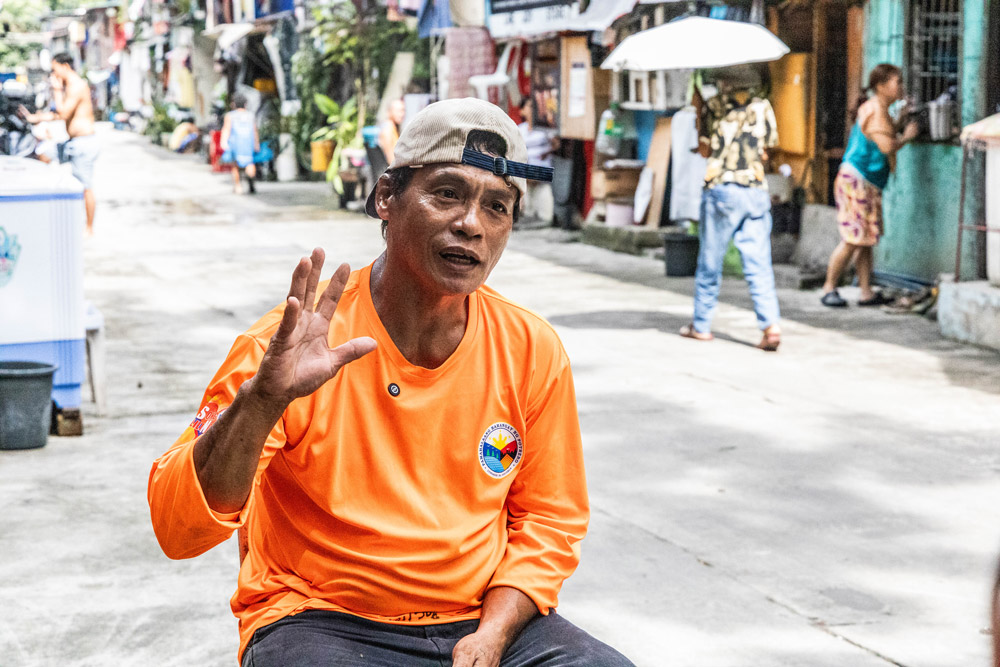
Long-time waste worker Gregorio Paclian Jr. shared how his role transformed dramatically. Instead of simply hauling garbage, he now acts as a policy enforcer, holding homeowners accountable for managing, collecting, and segregating the waste they produce. He and other workers also monitor trash coming from nearby companies and neighboring communities, making sure Potrero is no longer treated as another area’s dump.
“Napakahalaga ng role ng mga waste workers natin dahil sila ang nandun sa pinakababa,” explained Kgwd. Khate. “Kung wala sila, hindi natin maisasaayos ‘yung ating koleksyon ng basura o ‘yung pamamahala ng basura.” (“The role of our waste workers is extremely important because they are the ones on the ground. Without them, we wouldn’t be able to fix our waste collection or our waste management system.”)
Potrero’s waste workers also spearhead the collection of kalakal, salvageable or recyclable materials the barangay buys from residents.
What the Future Holds for Potrero and Similar Barangays
Potrero’s journey does not culminate in a perfect system, but rather in a hopeful one. Through ten years worth of work– the Zero Waste Program, and the Tingi Tindahan–the barangay has allowed people to better understand the consequences of single-use plastics, and the need to shift to reuse and refill systems.
Today, Potrero participates actively in reshaping its own narrative, with residents emboldened to lift themselves out of the torrents of plastic pollution. Through the work of residents, waste collectors, barangay leaders, and advocates, this community has shown that systems can shift and behaviors can evolve, even in places long defined by environmental struggle.

However, Potrero remains waiting for others to take action as they have: for fellow barangays to follow suit, for lawmakers to implement stronger policies aimed at safeguarding Potrero’s efforts, and for major corporations to finally put an end to plastic production and address the plastic waste generated by their products, much of which ends up choking waterways.
Even with the success of the Zero Waste Program, Potrero also still faces one persistent problem: residual waste from single-use sachets. Clean-up efforts, when done extensively, could rid the streets of trash and allow waterways to flow freely again, but it couldn’t stop companies from producing millions of single-use packaging including sachets or plastic packets.
Barangay Potrero still faces flooding to this day, and residents continue to sift through plastic waste. Until corporations stop producing single-use plastics and governments mandate a systemic shift to reuse systems, communities like theirs—around the globe—will remain burdened with the consequences of plastic pollution.

“As much as Barangay Potrero is a zero-waste barangay… the residual waste is still very hard to manage,” said Regine. “This is more on the plastic pollution component that they still have to face perennially… [Even with cleanup drives], hindi pa rin mawala-wala ‘yung hinaharap nilang problema sa plastic. So, that’s part of the challenge…” (“[Even with cleanup drives], the problem with plastic still doesn’t go away.”)
Kap. Sheryl echoed this: “Hangga’t may nagpo-produce ng plastic at may nagko-consume ng mga bagay na nakalagay sa plastic, hindi matatapos ang problema.” (“As long as plastic is produced and people consume products packaged in plastic, the problem will not end.”)
For Regine, the success of Potrero offers a viable model, but one that must be expanded intentionally.
Financial mechanisms are just as crucial. These stores, while well-meaning, still function within a business model, which means they need resources to start, expand, and sustain operations.
Regine hopes policies will eventually help zero-waste stores access grants and smoother supply chains that make refill options viable on a larger scale.
This entails the need for stronger local government support. “What if a zero-waste sari-sari store wants to scale up so that all products can be bought in refill form?” she asked. “May espasyo ba? May suporta ba ang barangay or local government?” (“Is there space? Is there support from the barangay or local government?”)
Municipalities must be prepared to help these models grow, not just in small stores, but eventually in bigger business formats such as groceries and supermarkets, where consumers can buy preferred brands in refillable, returnable containers.
For now, Potrero’s progress stands as a reminder that transformation becomes possible when people refuse to accept crisis as normal and when solutions are designed not only for the community, but with it.