The Reusable Cup Model Shows Promising Prospects for Plastic Reduction and Carbon Mitigation
When we think of summer music festivals, what usually comes to mind are rock, cheers, and beer-fueled excitement. Yet, when the stage lights go out and the crowd disperses, what remains is often a field strewn with trash and mountains of plastic cups. How can we turn these “wastelands” back into clean grasslands? And going a step further, how can large-scale events such as the Olympic Games move toward zero waste?
On September 25, the salon “Reusable Cups × Large-Scale Events: A New Track for the Green Economy” was jointly organised by Plastic Free China, Novaloop, Duck Gaga, and Guangdong Association of Circular Economy and Resource Comprehensive Utilisation, with support from Society of Entrepreneurs and Ecology Foundation. At the event, Fu Zhijian, Chief Engineer of the Guangdong Association of Circular Economy and Resource Comprehensive Utilisation, emphasised that disposable products cause resource waste, and green transition is essential to the high-quality development of sports events. Promoting reusable cups not only aligns with China’s “dual carbon” goals and plastic pollution control policies, but also fits perfectly with Guangdong’s vision of hosting green and sustainable events.
“As one of the hosts of the 15th National Games, Guangdong has made ‘green, shared, open, and clean’ its guiding principles, emphasizing ‘thrift in hosting’. Green building and energy-saving standards have been implemented across all venues to create a low-carbon sports event. This shows that green transition has become an essential element of high-quality development and the main theme for the growth of sports events. Concerts, music festivals, and other large-scale events are also facing an urgent need for green upgrades.”
Fu further pointed out that the reusable cup model not only enhances the green image of events but also drives the development of supporting industries such as collecting, cleaning, and logistic services, forming a sustainable closed-loop ecosystem. For example, the Leicester Tigers rugby club in the UK reduced over 16,000 single-use plastic cups per game through a reusable cup program. Similarly, the NBA’s Charlotte Hornets successfully introduced reusable cups at their home games, achieving efficient collection, cleaning, and reuse.
As a key figure in trail running and outdoor culture, “Outdoor Lao Luo,” founder of the West Lake Trail 30, noticed that single-use water bottles at aid stations were often discarded along the route andsometimes even picked up and carried back by runners. This inspired him to eliminate on-course water supply for the 30-kilometer race.
He believes that self-navigation and self-sufficiency should be basic capabilities for trail runners. However, after increasing food supply at the finish line, his team discovered that disposable tableware and wasted food filled up 20 trash bins. To address this, they encouraged participants to bring their own reusable plates. After five years of distributing reusable tableware, they finlly achieved a breakthrough—an 800-person race generating less than two bins of waste.
“China’s large-scale manufacturing capacity is unique, but mass production of disposable items also leads to significant waste and environmental harm. Moreover, due to rapid industrial turnover and diverse economic, cultural, and educational conditions, advancing the reusable cup model in China requires considering commercial viability—factoring in both environmental costs and the marketing benefits of sustainability.”
Outdoor enthusiast Wu Xiaowai went through a similar journey. As the owner of LAGOM ZAKKA, partner of Novaloop, co-initiator of “Sustainable Xiamen,” and founder of the “Zero Waste Event” and “Zero Waste Market” projects under Friends of Nature’s Linglong Initiative, she shared the zero-waste practice of a market in Ningbo, which used grade-B ceramic cups as rental cups. Customers paid a 1-yuan deposit to rent a cup and could get discounts from food stalls—recovering the cost in a single transaction.
“The key to a high return rate for reusable cups lies in selecting suitable event scenarios,” Wu explained. “Closed venues like arenas and music festivals make it easier for audiences to cooperate. But achieving plastic reduction and zero waste through reusable cups requires long-term, intensive promotion to build user habits.”
In Hong Kong, over 70,000 tons of plastic tableware are discarded every year—occupying landfill space, polluting the ocean, and posing a dual burden on the environment and resources. Seeing this urgent issue, ReCube Limited co-founder Kelvin Tsui and his team decided to act.
Founded in 2023, ReCube began as a student startup and evolved into a sustainable social enterprise offering reusable tableware rental services and a smart return network through partner restaurants. As of now, ReCube has partnered with 42 restaurants in Hong Kong, successfully reducing the use of more than 54,000 disposable items.

ReCube’s reusable cup service process for events.

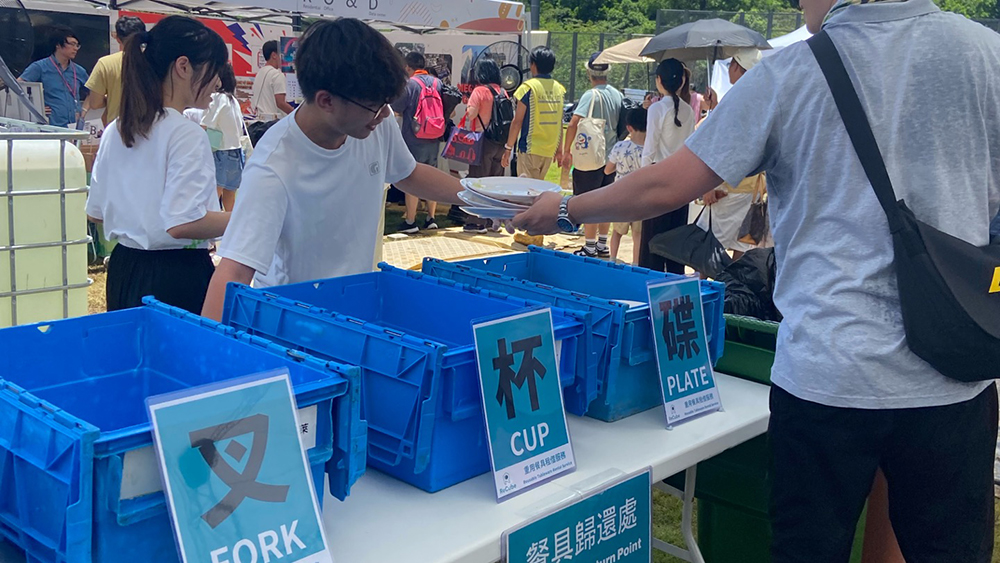
Image source: ReCube official website.
“Our experience shows that cost is a major concern for event organisers or venues when adopting reusable cups. Compared to single-use cups, reusable ones require extra costs for cleaning, logistics, and labour. We hope to reduce these costs through scale so that they won’t exceed disposables by much. However, small-scale events still face certain challenges.” Kelvin Xu summarised.
How much can reusable cups contribute to plastic reduction at events like the Olympics? Satoshi Hamanaka, representative of iPledge, shared their experience working with the Tokyo Olympic Organising Committee.
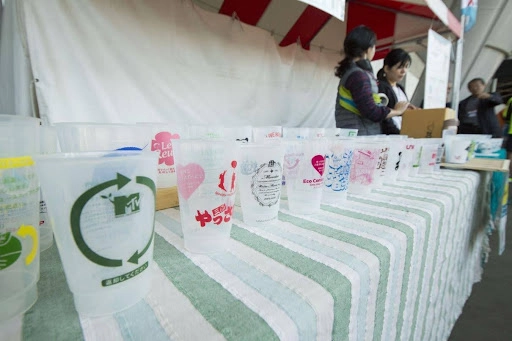
Image source: iPledge
Hamanaka explained that iPledge collaborates with large outdoor festivals to introduce reusable plates, bowls, and cups in place of disposables. They design collection and on-site cleaning workflows to ensure smooth operation even for events hosting tens of thousands of people.

Image source: AP Bank Fes (https://fes.apbank.jp/18/experience/eco)
At the same time, volunteers stationed at key points guide participants in waste sorting, reusable container use, and bringing their own bottles, making environmental action part of the festival experience. Over time, a “clean and sustainable” festival culture has emerged—turning environmentalism into a trend.
How effective has this been?
According to data and reports, continuous promotion has significantly reduced waste while improving audience satisfaction. FUJI ROCK Festival—the largest outdoor music event in Asia—has worked with iPledge (and its predecessor) for over 20 years on waste sorting and public engagement. It is now known by some media outlets as one of “the cleanest music festivals in the world.”
“In the past, people thought single-use cups were more hygienic and safer, but with growing environmental awareness, more people now accept reusable cups. National and local government policies and education play a key role here. In the future, reducing the cost of cleaning reusable tableware while ensuring hygiene will be critical to wider adoption.” summarized Satoshi Hamanaka.
Recently, a large fireworks display on the Qinghai–Tibet Plateau sparked heated discussion, once again putting environmental protection in the public spotlight. “The Chinese public’s environmental awareness is already strong; I believe most people genuinely agree that protecting the environment is the right thing to do.” Wu Xiaowei expressed her feelings and believed that the reusable cup would have a broader application prospect and environmental impact in the future.
Chen Aijia, project manager of Plastic Free China, noted that their 2025 survey on Chinese consumers’ perception of reuse models showed that 76% of respondents were willing to try reusable cups for environmental reasons. Among those unwilling, the main concern remained doubts about cleanliness and hygiene.
“Reusable cups are not just a green product—they represent a way to drive large-scale events and society toward sustainable transition. We’ve seen their potential in many settings, but we still need to keep working to overcome the challenges ahead.” concluded Xiao Lei, the host of salon and the podcast Half Latte | Business Tides.